By Adel Majd, Chief ExtraOrdinary Officer, Air Force Shield (how we write). Published , updated in HVAC Maintenance & Efficiency
Furnace cleaning and duct cleaning are two different jobs done by two different trades. A furnace cleaning, usually sold as a tune-up, is an HVAC technician servicing the burner, ignition, heat exchanger and safety controls of a gas appliance. A duct cleaning is removing dust and debris from the ductwork and the air-side parts of the furnace: the blower, the filter channel and the cabinet base. If your furnace is unreliable, noisy, or has not been serviced in years, you need the tune-up. If the ducts are full of renovation dust, pet hair or debris, you need the cleaning. Many homes need both, and they are not substitutes for each other.
What duct cleaning is
Duct cleaning is source removal: physically taking dust and debris out of the supply and return ducts, the main trunks, and the parts of the furnace that air passes through. The US EPA's page Should You Have the Air Ducts in Your Home Cleaned? says a provider should agree "to clean all components of the system," and that after the job "you should not be able to detect any debris with the naked eye." NADCA, the US industry association, publishes the ACR Standard as the industry reference for how that is done.
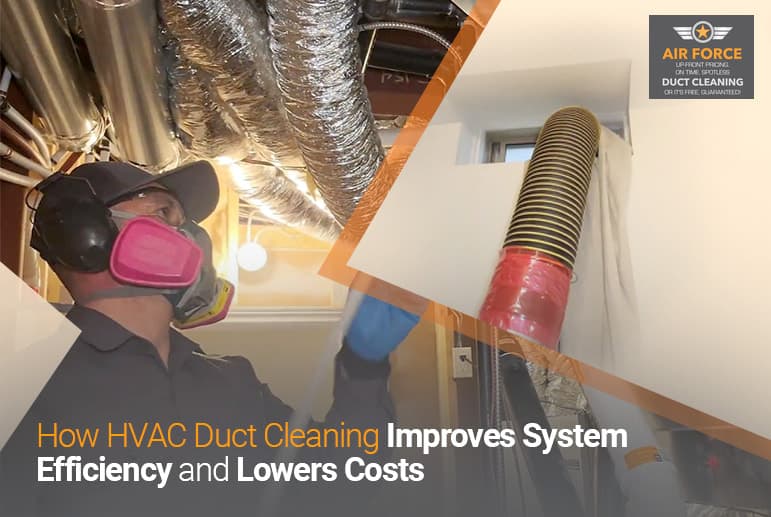
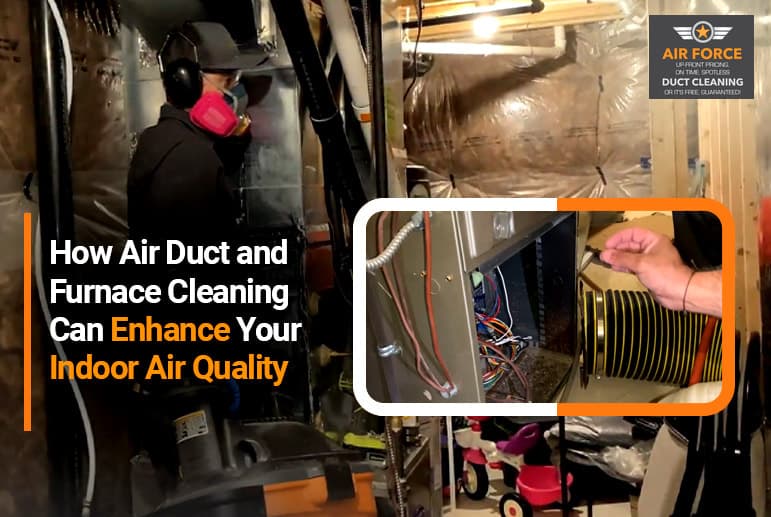
In our 12-step process, the air-side furnace components are included, not an extra. Steps 8 and 9 are the furnace J-channel (the slot the filter sits in, where bypass dust collects) and the blower and furnace base (the blower wheel, its housing, and the floor of the cabinet where debris settles). Those are reached by opening the blower compartment, which does not involve the gas train. The remaining steps are the ducts themselves: registers sealed, truck-mounted vacuum on the main trunks, every supply and return pressure-cleaned, trunks brushed, access points sealed, photos before and after.
A CMHC fact sheet on duct cleaning found that cleaning ducts alone made "little or no discernible differences" to airborne particles or airflow, but that cleaning furnace and air conditioning components such as the fan blower and coil "has been shown to make some difference in duct air flow." That is why a duct cleaning that skips the blower is not worth paying for.
What furnace cleaning is
"Furnace cleaning" on an HVAC company's invoice almost always means an annual service or tune-up of the appliance itself. The exact checklist varies by company, but it is combustion-side work: inspecting and cleaning the burners, checking the ignition and flame sensor, inspecting the heat exchanger for cracks, checking the venting, testing safety controls and limits, measuring gas pressure and temperature rise, and checking the condensate drain on a high-efficiency unit. It is done by a technician who works on the gas appliance, and it is about safe, reliable operation rather than dust.
In Ontario, this is regulated work. The Technical Standards and Safety Authority (TSSA) states that "furnaces and fuel-fired appliances must be maintained by TSSA-registered contractors" who employ certified gas technicians, and that "Registered Fuels Contractors are the only businesses that are legally authorized to do fuels related work in Ontario." You can verify a contractor on TSSA's registry before booking. Air Force Shield is a duct cleaning company, CNADCA certified (company ID CA-00153); we do not do burner, heat exchanger or combustion work, and we will tell you to call an HVAC contractor if the pre-inspection turns up something that needs one.
Side by side
| Component or task | Duct cleaning (Air Force Shield) | Furnace tune-up (HVAC contractor) |
|---|---|---|
| Supply and return ducts, main trunks | Yes | No |
| Registers and grilles | Yes | No |
| Filter channel (J-channel) | Yes | Filter check or swap, typically |
| Blower wheel, housing and furnace base | Yes | Sometimes inspected; cleaning varies |
| Burners, ignition, flame sensor | No | Yes |
| Heat exchanger inspection | No | Yes |
| Gas pressure, safety controls, venting | No | Yes |
| Dryer vent, HRV, humidifier, bathroom exhausts | Add-ons, $90 each | Not usually |
| Who does it | Duct cleaning technician | TSSA-certified gas technician |
Which one do you need?
You need a furnace tune-up when
- The furnace short-cycles, fails to light, or shuts off on a safety limit.
- It has not been serviced in more than a year, especially before the heating season.
- You smell gas or exhaust, or a carbon monoxide alarm has sounded. Treat these as urgent and call a gas contractor, not a duct cleaner.
- You are buying or selling a home and want the appliance inspected.
You need a duct cleaning when
- There is visible debris in the returns, dust puffs from the registers on startup, or a renovation has just finished.
- There has been a pest problem or visible mould in the ductwork (the EPA's own conditions for cleaning).
- It has been 3 to 5 years since the last cleaning, or you have just moved in and have no history.
You need both when
A new-to-you house that has had neither, a furnace that is fine mechanically but has a blower caked in renovation dust, or a system where the HVAC technician's inspection notes a dirty blower and recommends a cleaning. Order matters a little: if the ducts are badly contaminated, clean them first so the technician's filter and airflow readings are taken on a clean system. If the furnace is unsafe, that comes first regardless.
DIY vs professional
Some of this is homeowner work and the EPA says so. What you can safely do yourself:
- Change the filter. The EPA's first prevention step is to "change filters regularly," use the highest-efficiency filter the manufacturer recommends, and make sure air cannot bypass it. This is the single most useful thing on this list.
- Clean the register covers. Lift them, wash them, and vacuum the first foot or so of the duct boot with a hose attachment.
- Vacuum the return grille and what you can reach below it. CMHC's fact sheet notes return ducts are usually the dirtiest and that "much of the return air duct cleaning" near the grille can be done with a household vacuum after removing the grille. CMHC adds: "Do not expect any difference in airflow or house air quality after this cleaning."
- Keep humidity in range. Health Canada's moisture and mould guide recommends "maintaining relative humidity levels between 30% and 50%, using a dehumidifier as necessary." That does more to prevent growth in ducts than any cleaning.
What you cannot do yourself:
- Clean the trunks and long runs. They need negative pressure from a vacuum connected at the trunk, with the registers sealed, so what you loosen leaves the house instead of blowing into the rooms. A shop vacuum at a register moves dust around.
- Clean the blower wheel properly. It means opening the blower compartment, and in many furnaces removing the blower assembly, with power off. Do not attempt it unless you are comfortable with that; a bent wheel vibrates and fails.
- Any gas-side work. Burners, heat exchanger, gas valve, venting. In Ontario that is work for a TSSA-registered contractor, and doing it yourself is both unsafe and outside what the law allows.
- Apply biocides or sealants. The EPA says to be cautious about both and to check what your ducts are made of before anyone applies a biocide. CMHC advised against letting a cleaner fog the ducts. We use Benefect, a botanical disinfectant, as step 10; ask about it when you book if you would prefer to skip it.
What it costs
Duct cleaning is priced by home size, not per vent: a house with one furnace is $399 under 2,000 sq ft, $449 for 2,001 to 3,000 sq ft, and $499 for 3,001 to 4,000 sq ft, before HST, with each additional furnace $200. The full table is on the duct cleaning cost page, and the scope is on the residential duct cleaning page. We cannot quote a furnace tune-up; that is an HVAC contractor's price, and it is worth asking them exactly which of the items in the table above are included so you are not paying twice for the blower.
Frequently Asked Questions
Does duct cleaning include the furnace?
Ours includes the air-side parts of the furnace: the J-channel filter slot, the blower wheel and housing, and the furnace base. It does not include burners, the heat exchanger or any gas work.
Does a furnace tune-up clean the ducts?
No. A tune-up services the appliance. Some technicians will vacuum the blower compartment, but the ducts, trunks and registers are not part of it.
Can a duct cleaner work on my gas furnace?
Only on the air side. In Ontario, TSSA states that furnaces and fuel-fired appliances must be maintained by TSSA-registered contractors using certified gas technicians. A duct cleaner opening the blower compartment is not touching the gas train.
Which should I book first?
If the furnace is unsafe or not running properly, the HVAC technician first. Otherwise, clean the ducts first so the tune-up's airflow and filter checks are done on a clean system.
Can I clean my own ducts?
You can change the filter, wash register covers and vacuum what you can reach at the return grille. The trunks, long runs and blower need a vacuum connected at the trunk with the registers sealed, which is the professional job.
Ready for cleaner air?
Get an instant quote online, or call us and talk to a certified technician.