
By Adel Majd, Chief ExtraOrdinary Officer, Air Force Shield (how we write). Published , updated in Duct Cleaning Guides
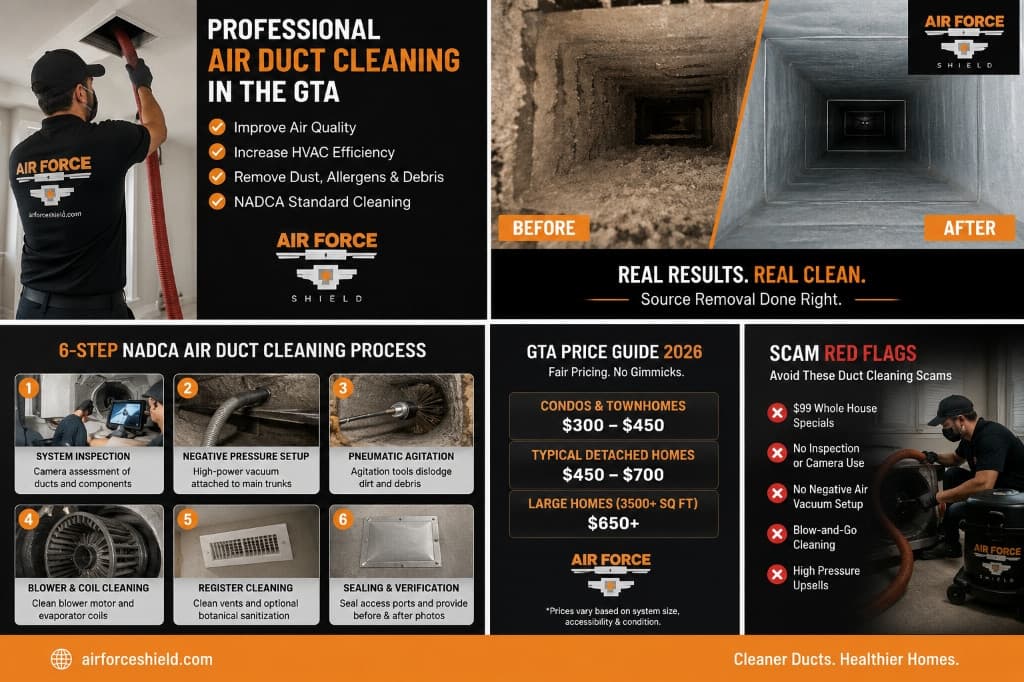
Air duct cleaning in the GTA is worth paying for when there is something in the ducts to remove: renovation dust, pet hair, a past pest problem, or a system that has never been cleaned. It is not a routine health treatment, and the US EPA says plainly that it has never been shown to prevent health problems. A proper whole-house cleaning in Toronto and the GTA costs $399 to $499 before HST, takes about 1.5 hours, and uses a truck-mounted vacuum. The $99 phone offer is a different service entirely, and this guide explains how to tell the two apart.
Key takeaways
- A targeted service. Duct cleaning is mechanical maintenance for specific triggers (renovations, heavy buildup, mould, pests, a never-cleaned system), not a cure for allergies.
- Source removal is the only real method. A high-volume vacuum pulls negative pressure on the trunk lines while brushes and compressed air dislodge what is stuck to the duct walls.
- Realistic pricing. $399 for a house under 2,000 sq ft or a single condo unit, $449 up to 3,000 sq ft, $499 up to 4,000 sq ft, before HST. A whole-house price under $200 is a red flag.
- Daily care does the rest. Changing the furnace filter on schedule and keeping indoor humidity in check matter more for day-to-day air quality than any one-off cleaning.
Duct cleaning is neither a miracle nor a hoax. Done properly it removes what has settled inside the system and restores airflow to the rooms at the end of the line. Done badly it leaves the dust where it was, or blows it into your living room. The sections below cover what legitimate cleaning involves, when a home needs it, what fair GTA pricing looks like, and how to spot the scams.
What air duct cleaning actually is (and what it is not)
Before you compare quotes, it helps to know what you are buying. The industry reference is the method the National Air Duct Cleaners Association (NADCA), the US association, calls source removal, and it is the same method the Canadian body, CNADCA, certifies companies on. Air Force Shield is CNADCA certified (company ID CA-00153).
Source removal means mechanically agitating the inside surfaces of the duct system while a high-capacity vacuum holds the whole system under negative pressure. For houses, that vacuum is truck-mounted and rated up to 20,000 CFM, connected directly to the main supply and return trunks. Compressed-air tools and contact brushes then work down every branch, dislodging what is bonded to the duct walls and sending it toward the vacuum. Nothing is blown into the rooms, because every register has been sealed first. For high-rise condo suites, where a truck cannot reach, the same job is done with a portable vacuum and compressor at the wall unit.
For the equipment-by-equipment version, see our guide on how air duct and furnace cleaning works.
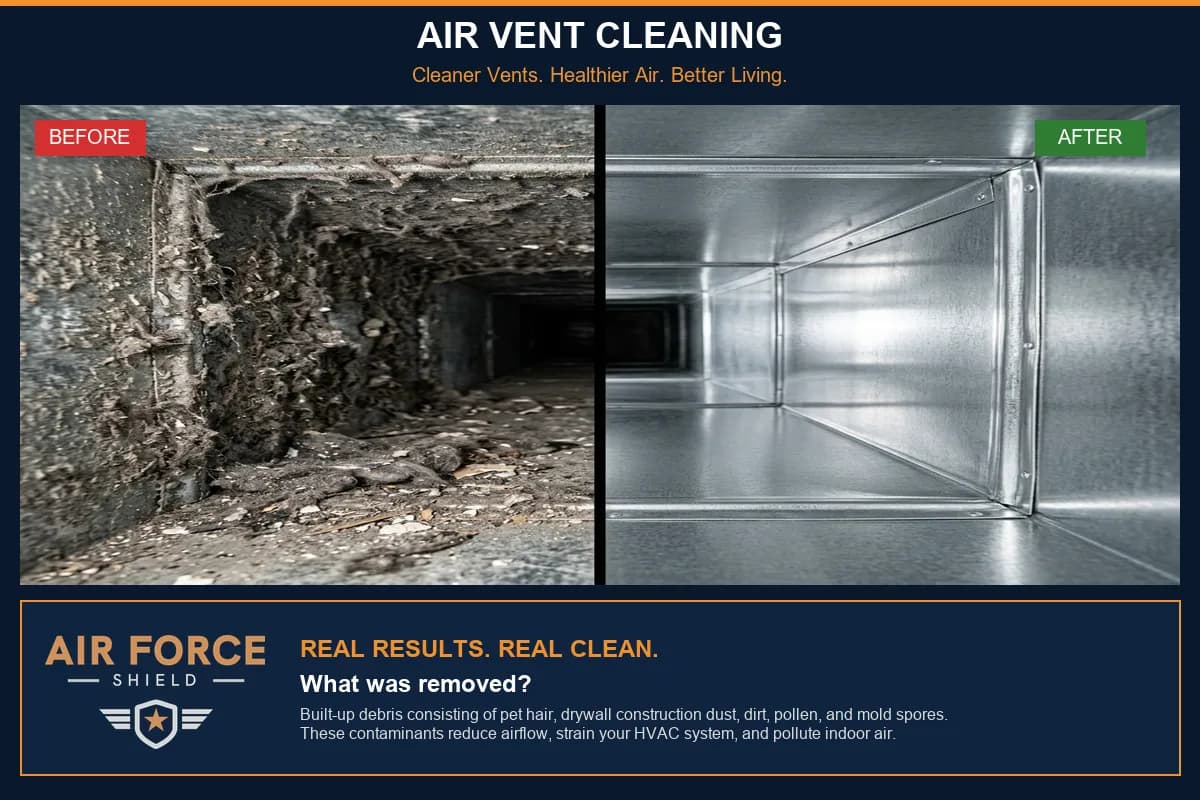
Genuine source removal
- High-volume vacuum holds negative pressure on the trunk lines for the whole job.
- Brushes and compressed air dislodge bonded dust from every branch, not just the register mouths.
- Cleans the whole air path: supply, return, main trunks, the furnace J-channel, and the blower.
- Before-and-after photos emailed to you.
The $99 blow-and-go shortcut
- A shop vacuum or small portable unit held at each vent opening.
- No trunk-line connection, no sealing of registers, no agitation.
- Loosened surface dust blows into the rooms when the furnace next starts.
- Relies on a hard upsell, usually "mould treatment" or a new furnace, to make the visit pay.
The 12-step house cleaning process
A legitimate cleaning follows a fixed order so that dust travels one way only, toward the vacuum, and so that nothing is skipped. This is the process Air Force Shield runs on every house, and it is laid out in more detail on our duct cleaning process page.
- Arrival and protection. Corner guards on walls and floor mats on the route from the door to the furnace.
- Pre-inspection and photos. The technician looks inside the trunks and photographs the starting condition.
- Seal supply and return vents. Every register is covered so the vacuum pulls through the ducts, not the rooms.
- Connect the truck-mounted vacuum to the main supply and return trunks.
- Pressure-clean each supply vent. Compressed air and brushes push debris from each branch back toward the trunk.
- Pressure-clean each return vent. The return side carries the most dust and gets the same treatment.
- Main trunk cleaning. Contact brushing, suction and compressed air along the full length of the trunks.
- Furnace J-channel. The channel where the filter sits is cleared.
- Blower and furnace base. The blower compartment and the base of the furnace are cleaned.
- Benefect sanitizing. Benefect, a botanical disinfectant, is applied through the system.
- Seal access points. Any access opening cut into the ductwork is covered and sealed.
- Post-inspection and photos. The same spots are photographed again and the pictures are emailed to you.
Expect about 1.5 hours on site for a house, and about 45 minutes for a condo suite. A crew that is in and out in forty minutes has not done steps 5 through 9.
The equipment that makes it possible
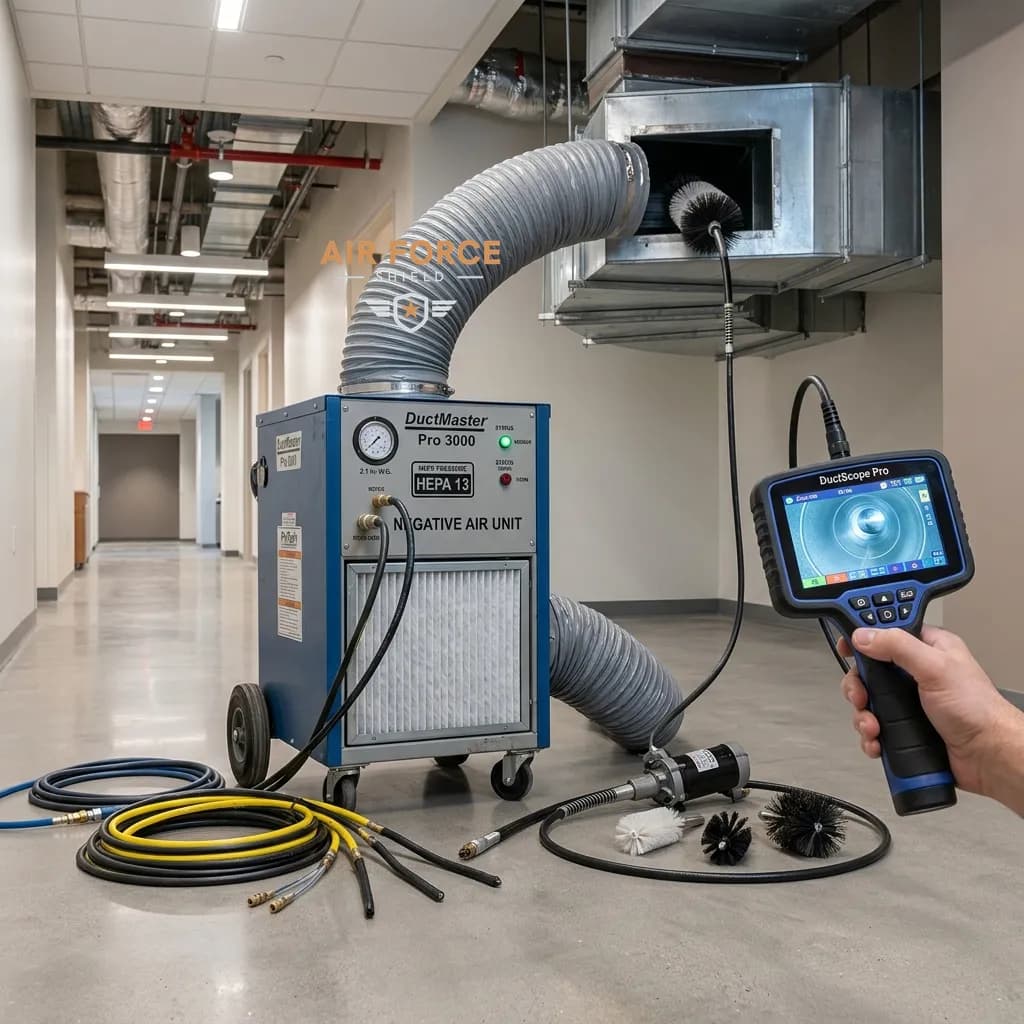
If a technician arrives with only a household shop vac and a hand brush, they cannot do source removal, whatever the flyer promised. The job needs a vacuum big enough to hold the whole system under negative pressure, compressed-air tools long enough to reach the end of each branch, and contact brushes for the trunks. Ask what vacuum they use before you book.
When duct cleaning is actually warranted
The EPA's guidance is the most honest summary available: duct cleaning "has never been shown to actually prevent health problems", and "little evidence exists that cleaning only the ducts will improve the efficiency of the system". The same page does say that cleaning dirty cooling coils, fans and heat exchangers can improve efficiency, and it names three situations where cleaning makes sense: substantial visible mould growth inside hard-surface ducts, ducts infested with rodents or insects, and ducts clogged with excessive dust and debris.
To that list most GTA technicians would add two local realities: a house that has just been renovated, and a house that has never been cleaned since it was built. Both are common in the new subdivisions of Milton, Brampton and Markham and in the finished-basement streets of North York and Scarborough. For the mechanical side, how restricted airflow loads the blower and fouls the coil, read how dirty ducts affect your HVAC system.
| Situation | Cleaning recommended? | Why |
|---|---|---|
| Major renovation or basement finish | Yes | Drywall dust and sawdust bypass the filter and settle in the trunks and blower. |
| Visible mould inside the ductwork | Yes, with the moisture source fixed | Removes the growth; the leak or humidity problem has to be solved or it returns. |
| Past rodent or insect activity | Yes | Removes nesting material and droppings from the air path. |
| Never cleaned, house 10+ years old | Yes | Construction debris from the build is usually still there. |
| Light household dust, no triggers | No | Settled dust on duct walls mostly stays put. Change the filter and wait. |
| Mild allergies, nothing else | Start with the filter | Cleaning is not a treatment. A better filter and a room air cleaner usually help more. |
| $99 flyer or cold call | No | The price cannot cover a real cleaning. It is a door-opener for an upsell. |
Five signs your GTA home needs duct cleaning
- A puff of dust when the furnace starts. Loose debris at the register mouths gets pushed out on each cycle.
- Renovation dust in the returns. Fine grey powder on the inside of the return grilles after a kitchen, flooring or basement project.
- A musty smell from the vents. Stale or earthy odour that gets stronger when the fan runs points to damp dust or past pest activity.
- Debris on the blower. A mat of dust on the blower wheel or the furnace base when you change the filter.
- Evidence of pests. Droppings, nesting material or insect casings at a vent or in the furnace cabinet.
For the allergy side of the question, see what duct cleaning can and cannot do for seasonal allergies.
Real costs of air duct cleaning in the GTA
Air Force Shield prices by home size, not per vent, so the number you are quoted is the number on the invoice. Prices are in CAD before HST and include the full 12-step process above.
| Home | Price before HST | Notes |
|---|---|---|
| House, under 2,000 sq ft, one furnace | $399 | Full 12-step cleaning, before-and-after photos |
| House, 2,001 to 3,000 sq ft | $449 | Same scope |
| House, 3,001 to 4,000 sq ft | $499 | Same scope |
| House, over 4,000 sq ft | Quoted by phone | Call (416) 548-7833 |
| Each extra furnace | +$200 | Up to three furnaces |
| Condo, single unit | $399 flat | Vents, fan coil or wall unit, bathroom exhaust fans, dryer vent included |
| Condo, double unit | $599 flat | Same inclusions |
| Add-ons (house or condo) | $90 each | Dryer vent, HRV, humidifier, or three bathroom and laundry exhausts. Book two and the third is free. |
Repeat clients get 5% off the cleaning (not the add-ons), and every job is covered by the "Love it or don't pay" guarantee. For a fuller breakdown, including what drives a quote above the base price, read our duct cleaning cost guide for Toronto, or get a quote in a couple of minutes. We serve Toronto and the rest of the GTA: Peel, York, Halton, Durham and Simcoe.
The telemarketing scam, and how to recognise it
Most GTA households have had the call: an unfamiliar number, a scripted voice, a whole-house cleaning for $99 or $129, "we are in your area this week". A 2013 CBC Marketplace investigation hired several Toronto duct cleaners through these calls, using hidden cameras. The telemarketers used spoofed phone numbers to hide where they were calling from. In two homes the crews finished in about an hour and charged $115 and $99 before tax. The expert who inspected the work found one duct with close to four centimetres of dust before the cleaning and, in his words, "it hasn't moved, not even an inch" afterwards. One worker said his boss gave him an hour per job and booked as many as eight in a day.
The pattern has not changed much since. The warning signs are:
- The price is impossible. Two technicians, a truck and an hour and a half on site cannot be sold for $99. The money comes from what they find once they are inside.
- The upsell arrives on cue. "Mould" discovered in the first ten minutes, a "sanitizing" charge of several hundred dollars, or a furnace that suddenly needs replacing.
- No company name you can check. Ask for the legal business name, the address, and whether they are CNADCA certified. Then look it up before they arrive, not after.
- No photos. A company that does the work properly wants you to see it.
If a technician announces dangerous mould, do not pay for anything on the spot. Ask for the moisture source, ask for photos, and get a second opinion. Mould in a duct system is a water problem first, and cleaning it without fixing the water only buys a few weeks.
Homeowner quality checklist
Use this before, during and after the appointment.
- Clear the furnace. About a metre of space around the unit and access to the main trunks.
- Watch the vacuum connection. The hose should go into the main trunks, and the registers should be sealed while it runs.
- Look for agitation. Air tools or brushes should go down every branch, not just the ones nearest the furnace.
- Inspect the access seals and ask for the before-and-after photos before the crew leaves.
Keeping the system clean between visits
Between cleanings, the furnace filter does the work. A pleated filter changed on the manufacturer's schedule, more often with pets or during renovations, stops most of what would otherwise settle in the returns. Keep return grilles clear of furniture and rugs, keep indoor humidity moderate so dust does not dampen and stick, and have the furnace itself serviced on the schedule your installer recommends. With those habits, most GTA homes need a professional cleaning every three to five years, sooner with pets, allergies, or after a renovation.
Frequently Asked Questions
How often should air ducts actually be cleaned?
Every three to five years for most GTA homes, and sooner after a renovation, after a pest problem, when there are shedding pets or allergy sufferers in the house, or when you move into a home with no record of a cleaning.
Does duct cleaning help with allergies?
It removes the dust, dander and pollen that have collected in the system, so there is less of it to recirculate. It is not a treatment, and the EPA says cleaning has not been shown to prevent health problems. A better furnace filter and a room air cleaner usually do more for symptoms than any one-off service.
How long does a proper duct cleaning take?
About 1.5 hours for a house, depending on size and number of furnaces, and about 45 minutes for a condo suite. A whole-house job finished in under an hour has skipped most of the process.
Will duct cleaning make a mess in the house?
No. With every register sealed and the vacuum connected to the trunks, loosened dust travels toward the vacuum and out of the house. Floor mats and corner guards protect the route to the furnace.
What should I do if a technician says I have dangerous mould?
Do not pay for remediation on the spot. Ask for photos, ask where the moisture is coming from, and get a second opinion. Mould in ductwork is a water problem; cleaning without fixing the source does not last.
Is the price per vent or per house?
Per house, by size. Under 2,000 sq ft is $399, up to 3,000 is $449, up to 4,000 is $499, all before HST, with an extra furnace at $200. Condos are a flat $399 for a single unit. Per-vent pricing is one of the ways a low headline number turns into a large invoice.
Ready for cleaner air?
Get an instant quote online, or call us and talk to a certified technician.