By Adel Majd, Chief ExtraOrdinary Officer, Air Force Shield (how we write). Published , updated in Air Quality & Health
Duct cleaning helps seasonal allergy households in one specific way: it removes the dust, pet dander and pollen that have collected inside the system, so the furnace fan has less of it to send back into the bedrooms. It does not change the pollen count outside, and it is not a treatment. The US EPA says duct cleaning has never been shown to prevent health problems, and that is the right place to start. What follows is what cleaning can do, what it cannot, and what GTA homes with allergy sufferers should do alongside it.
Where the pollen comes from across the GTA
The GTA is not one allergy environment. The triggers depend on what surrounds the house.
- Halton Hills. Georgetown sits in the Credit River valley with farmland and woodlots on every side, and Acton is surrounded by fields and escarpment countryside. Tree pollen in spring and ragweed in late summer are the complaints we hear most there, and farm dust arrives on windy days during planting and harvest.
- Toronto's ravines. Homes backing onto the Don, Humber and Rouge valleys and the smaller ravines through midtown and North York take in tree pollen in spring and leaf mould in the fall, much like a rural property.
- The lakeshore. From Etobicoke through Oakville and Burlington, lake humidity swings through the year. Damp air moving through dusty ducts is what produces the musty smell when the system first starts, and damp dust holds onto pollen rather than letting it blow through.
- 905 subdivisions. Newer streets in Milton, Brampton, Vaughan and Whitby have a different problem: construction dust from the build, and from the lots still being built next door, has often never been cleaned out. Pollen lands on top of it.
Whatever the source, the route indoors is the same. Pollen comes in through open windows, on clothing and on pets, settles on floors, and is pulled into the return grilles each time the fan runs. Some of it is caught by the filter. Some settles in the return trunks and on the furnace base, where it stays until the next fan cycle lifts a little of it back into circulation.
What duct cleaning can do
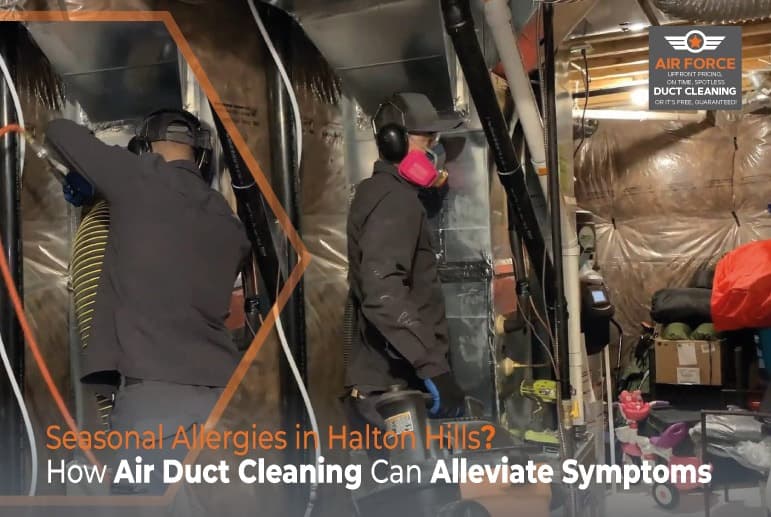
A proper cleaning removes what has accumulated. On a house that means every supply and return branch, the main trunks, the furnace J-channel and the blower, with a truck-mounted vacuum holding the system under negative pressure while brushes and compressed air work each run. For allergy households Air Force Shield concentrates on the return side and the furnace base, where most of the collected material sits, and finishes with Benefect, a botanical disinfectant. You receive before-and-after photos of the same spots.
The result is a system with less in it. If the ducts were carrying years of dust, dander and pollen, that reservoir is gone, and the fan is no longer redistributing it. That is a real and visible change. The residential duct cleaning page covers the full scope and what is included.
What duct cleaning cannot do
It cannot reduce the pollen count in the garden, stop pollen coming in with the dog, or treat rhinitis. The EPA's position is that cleaning has not been shown to prevent health problems, and that most of the dust in ducts adheres to the surfaces rather than entering the living space. If a company tells you a cleaning will cure your allergies, that is a sales line, not a fact. What cleaning does is remove one indoor source. Whether that changes how you feel depends on how much was in the ducts and what else is going on in the house.
It is also not a substitute for the filter. A system cleaned in April with a filter that is never changed will be collecting pollen again by June.
Signs the ducts are part of the problem
Allergy symptoms that are worse at home than outside, worse at night, or that start when the heating or cooling comes on are the pattern that points to the ducts. So is a puff of dust from the registers at startup, grey fuzz on the inside of the return grilles, or a system that has not been cleaned since the house was built. Our guide to the signs your ducts need cleaning goes through each one. If none of them apply, start with the filter and a room air cleaner before booking anything.
Timing a cleaning around allergy season
Clean before the season that bothers you most. Late winter, ahead of tree pollen, suits spring sufferers. Mid-summer, ahead of ragweed, suits late-summer sufferers. Cleaning at any time still removes what has already collected, so there is no wrong month, but a cleaning done just before the closed-window heating or cooling season means the fan starts the season with a clean system.
The company recommends cleaning every three to five years for most homes, and sooner with pets, allergies or after a renovation. For an allergy household, the shorter end of that range is reasonable.
What to do alongside cleaning
- Change the furnace filter on schedule. Check it monthly during pollen season and replace it when it is visibly loaded. A filter that is overdue restricts airflow and stops catching what it should.
- Keep return grilles clear. Natural Resources Canada's home maintenance guidance advises keeping return air grilles and heating vents clear of furniture. Rugs and drapes over returns pull dust from the floor straight into the system.
- Close windows on high-pollen and windy days. Especially in Halton Hills and Acton during planting and harvest, and anywhere near a ravine in spring.
- Use a room air cleaner in the bedroom. For symptoms at night, a portable unit in the room where you sleep addresses the air you actually breathe.
- Manage humidity. Damp air near the lake makes dust stick and gives mould a foothold. Keep the house dry enough that windows do not fog.
Service across the GTA
Air Force Shield is CNADCA certified (company ID CA-00153) and cleans homes seven days a week across Toronto, Peel, York, Halton, Durham and Simcoe. In Halton Hills see the Georgetown and Acton pages, which cover Glen Williams, Norval, Limehouse and the rural hamlets as well. Lakeshore homes are covered on the Oakville page. Pricing is by home size, from $399 before HST for a house under 2,000 sq ft, and you can get a quote online in a couple of minutes.
Frequently Asked Questions
Can duct cleaning cure seasonal allergies?
No. It removes the dust, dander and pollen that have collected in the system so the fan is not recirculating them, which is a real change in a dirty system. It does not change outdoor pollen, and the EPA says cleaning has not been shown to prevent health problems. Treat it as removing one source, not as a treatment.
When is the best time of year to clean ducts for allergies?
Before the season that bothers you most: late winter ahead of tree pollen, or mid-summer ahead of ragweed. Cleaning at any other time still removes what has already collected.
Is Benefect safe for people with sensitivities?
Benefect is a botanical disinfectant, and it is the only sanitizer Air Force Shield uses. If anyone in the house reacts to scents or plant oils, tell us when you book and we can discuss skipping that step.
How often should an allergy household clean its ducts?
The company recommends every three to five years for most homes, and sooner for homes with allergies, pets or recent renovations. The shorter end of that range is sensible if symptoms are clearly worse indoors.
Will a better furnace filter do more than duct cleaning?
For day-to-day pollen, often yes, because the filter works continuously while a cleaning is a one-off. The two do different jobs: the filter catches what reaches it, the cleaning removes what has already settled. Do both.
Ready for cleaner air?
Get an instant quote online, or call us and talk to a certified technician.